The Council of Europe’s Enlarged Partial Agreement on Sport (EPAS) is organising a Breakfast Roundtable on women’s health and sport on the occasion of International Women's Day. The event will take place on Friday 7 March 2025 from 9.30 am to 12.00 noon (CET, Strasbourg time).
The roundtable will bring together international experts and guests who will deliver presentations about initiatives in place to ensure that women and girl’s health in sport is factored in in practical terms and will set forth some of the major areas of concern, including physical health and mental health issues, amongst other topics. There will be two panels, one focusing on lived experiences, and a second one looking into practical solutions to improve the situation for girls and women taking part in sport.
The programme of the event is available here
The meeting of the Science, Culture and Education Commission (CCSE) of Panathlon International (PI) took place on-line on 13 February.
All the members were present: Fabio Figueiras, Kole Gjeloshaj, Raffaella Masciadri, Carla Spielmann besides the President of the CCSE Antonio Bramante, the International President Giorgio Chinellato, the IB member Christian Garrabos, the Secretary General Simona Callo and Debora Quercioli (General Secretariat).
Various topics were discussed including changing the name of the Commission, introducing the word ‘research’, planning webinars, producing contributions to write articles for communication, and collaborating with other organizations.
It was proposed to organize the first webinar on the topic of physical activity for the second half of March, with Dr. Victor Matsudo as guest speaker, and to continue with bi-monthly editions in the following months. The creation of a Club Prize for the best project on the Congress theme was also proposed, to be awarded in 2026.
The International President, Giorgio Chinellato, emphasized the importance of involving the Paralympic Committee and the IOC, while President Bramante invited the members to express their area of specialization. The discussion also touched upon an innovative project in collaboration with Belgian universities to create a network of young students committed to ethics in sport, which has already been approved by PI.
Finally, the problem of the language barrier in webinars was addressed, proposing to translate materials and adapt formats to reach a global audience. The meeting concluded with a commitment to continue the discussion via email.
The Special Olympics Winter World Games in Turin are approaching, but while waiting for the opening ceremony that will take place on 8th March, the 25th of February was a very important day.
In fact, the Special Olympics Community Run took place simultaneously throughout Italy.
20 cities, 1000 runners, half of whom were Special Olympics athletes, carried the Olympic flame through the various cities, involving schools, associations and volunteers to send a very strong message of awareness and inclusion throughout the country.
It was even more special in Venice, where the Olympic Torch is traditionally escorted by the police. In fact, the torch was carried from the Venice Police Headquarters, where the police and local police runners met with the special athletes and volunteers of the Venice Marathon to welcome the arrival of the lantern and watch the Prefect light the torch. From here the procession started, escorted as always, and carried the fire of Olympia to the Campo della Salute. Here, in front of the stage where the authorities were seated, the Olympic brazier was lit and, with the blessing of the Patriarch, the torch was returned to the police headquarters by water, as tradition dictates.
On the stage of authorities, representing Panathlon, was the President of Panathlon International, Giorgio Chinellato. The President of the Panathlon Club Venice, Diego Vecchiato, and the past president, Giuseppe Zambon were also present.
President Giorgio Chinellato's presence was important and greatly desired and testifies to his sensitivity towards the world of Paralympic sport. It's a feeling that was born the first time he had to deal with special athletes in the pool, when in the water these extraordinary people find their magnificent dimension and move with ease. And it's a bond shared with his friend and panathlete Elisabetta Pusiol, Director of the Veneto Region of Special Olympics Italy, who was also present in the front row at the event.
The friendship is long-standing, and their shared passion for the world of Paralympic movement has constantly strengthened it, offering them many magnificent moments in which the athletes have been able to pass on valuable lessons and truly extraordinary emotions.
It is certainly no coincidence that the President wanted to keep the delegation for Paralympic sport for himself. "I have always been close to the extraordinary world of Paralympic athletes, magnificent people. Elisabetta Pusiol, Director for the Veneto region of Special Olympics, and I have been friends since our school days, and over time we have shared many occasions when we have worked for special athletes, all very exciting. Among many other episodes, I fondly remember an improvised fundraising to enable our Italian team to fly to the World Championships in Mexico in 2004, and a magnificent parade in Venice with athletes from all over the world parading in front of the stage in Piazza San Marco, with the banner of the Panathlon Club of Venice-Mestre bringing the procession to a close. Working with Paralympic athletes is wonderful, and what we receive in return for our work, what we learn from them, is priceless to say the least."
So, let's all get ready to support the Italians at the Special Olympics World Winter Games in Turin, which will certainly be a magnificent event.
The road to give the right visibility to the extraordinary people who train hard every day and give their all in the competitions they take part in is still long, but Panathlon is at their side and at the forefront of this noble battle, whose work and values it fully shares.
You can follow all the events of Special Olympics Italy on the website of the association or on its Facebook page.
by Mario Boranga
Communication delegate Panathlon Club Pordenone
The meeting of the President's Committee took place online on 31 January, during which several important topics were discussed for the future of the organisation.
Among the main items on the agenda, the PI's network of international relations with the most important associations involved in the promotion of Fair Play was discussed in depth. In this context, the appointment of Past President Pierre Zappelli as our representative on the CIFP Board was made official.
The cooperation with the ISOH (International Society of Olympic Historians), CIFP (International Fair Play Committee) and CIPC (Pierre De Coubertin International Committee) associations was confirmed. They are among the PI partners in the organisation of a special event in connection with the Paris 2024 Olympic Games. In this context, the date of the meeting between PI delegation and the Director of the IOC Olympic Foundation for Culture and Heritage was also confirmed for 13 March to introduce PI projects.
Ample time was dedicated to Erasmus projects. Fabio Figueiras, delegate for Erasmus projects, illustrated in a report, the opportunities that emerged during the Info Sport Day. Meanwhile, the President of District Belgium, Paul Standaert, together with Yves Vanden Auweele, joined the meeting and updated the Committee on the progress of the MAISI/DAISI project, which has already been approved by PI and further information will be provided to clubs.
Another important initiative was the project, endorsed by PI, suggesting asking UNESCO to proclaim 25 September as International Youth Sport Day for Education and Growth.
In addition to the international cultural activity, the request of some clubs to be able to voluntarily pay the fee proposed by the IB was welcomed, after the negative outcome of the vote on the fee increase during the General Assembly in December.
During the meeting, some delegations were redefined, including those related to Fair Play and PI Charters. The composition of the CCSE (Culture Commission) and the working group dedicated to expansion were confirmed.
The Committee announced, with great satisfaction, the birth of two new clubs: one in Rio de Janeiro (Brazil) and one in Frosinone (Italy), marking an important step forward for the organisation's growth. The issue of printing and translating the official magazine was also discussed as part of a cost containment policy.
The Committee was very pleased to announce the creation of two new clubs, one in Rio de Janeiro (Brazil) and one in Frosinone (Italy), marking an important step forward for the growth of the organization.
Other points were discussed and deliberated. The decisions, once final and translated, will be published as usual in the reserved area of the PI site.
by Alberto Bortolotti
The remembrance of Drazen Dalipagic cannot begin except with a kind of basketball homily by the greatest guru of their basketball, the Julian/Slovenian Sergio Tavcar: “... three champions that cannot be discussed were Dragan ‘Cobra’ Kićanović, Dražen ‘Praja’ Dalipagić and Vlade Divac. All of these were players who on the day gave the distinct feeling of being unmarkable, a characteristic that distinguishes the champion from the mere champion. On these players my conviction is of the 'Taucerian' type, that is, absolute.”
Speaking of definitions, in Belgrade Partizan fans used to call them “Kića i Praja, pobede bez kraja” (Kića and Praja, endless victories). And, as for personality, here's-perhaps-an urban legend: the story goes that, at some point during preparation, Dalipagić went to the granite Professor Nikolic, his coach, on behalf of the entire team. “Coach, maybe it would be better if you also listened to what we want. Because you the championship without us will not be able to win it, while we, even without you, could probably still win it.”
As for the 70-point record, I remember well that January 25, 1987, the day of 70 points. I was in the newsroom at Rete 7, waiting to make the full-bodied Sunday “Sport Today,” the sports newscast that could not avoid dealing in depth with Bologna, Fortitudo and Virtus (all playing on Sunday afternoons, the “lunch match” and “football night” were stuff, perhaps, from the NFL). A few weeks earlier we had called MartyByrnes, the algid, off-white foreigner brought in by a somewhat retreating Avvocato Porelli and who would, that Sunday at Arsenal, mark Praja Dalipagic (barring rare, unplanned moments in the zone), a “tristo”: a Bolognese adjective meaning poor. He raged about it but eventually agreed with us, in spite of the treatment that coach Sandro Gamba applied to that rebellious and uncombative outfielder. At the end of the season he was dismissed.
It amazed the scoreboard that said 70 points (the 3-point shot had come just three seasons earlier, but I almost think he would have made that haul anyway!) however, it did not amaze the hail of blows that sunk the black Vs among the Venetian calli. After all, Dalipagic was the one who “chewed up” 600 solo shots at the end of each practice, so much so that he had the custodian give him a copy of the gym keys because he, the Bosnian from Mostar when Bosnia-Herzegovina was still perhaps a region of the Titino empire, wanted to exercise the basically peculiar characteristic of basket ball: the basket, indeed. It's called “basket ball,” this sport, I often remind my friend Ettore Messina of it, too. And of the deep essence of that sport Dalipagic was probably the most faithful, attentive interpreter, a kind of guardian of the Holy Grail: the shot, in its absolutism and in its technical and stylistic purity. A living manual.
In 1987 Praja had just retired from the “plavi” national team, which then defunct, as an entity, in '91 in Rome when Slovenia came out first from Yugoslavia and Jure Zdovc was removed, as if he were a thief, from the Capitoline retreat. His generation predates the glittering generation that so many remember: the Petrovic, Kukoc, Radja, Savic, Divac, Danilovic, Djordjevic, and 100 others we could name.
All I know is that, for us high schoolers discovering color on TV and irreverent commentaries from Koper/Capodistria, almost always with the unmistakable voice of Sergio Tavcar, there was a trimurti. The Three Gods of the time were Mirza Delibasic, point guard, DraganKicanovic, guard, Drazen Dalipagic, wing.
Ah, if you don't believe in the possibility of 70 points “without 3-point shooting,” read this Udinese anecdote. 46 points, then the next week 50, “without 3 point line.” But let's go in order.
During one of the shooting sessions the young assistant coach Colosetti had occasion to tell the champion from Mostar that before him he had known and coached one of his peers, Walter Szczerbiak.
“In a shooting session with Praja I told him that I had worked with another great shooter in Udine: Walter.” Lapidary was the response of the astonished Dalipagic: “Yes, great hand, but I am more complete because I also play one-on-one and create my own shot.”
The coach again: “Drazen took us to A1 by winning the top scorer title and scoring 46 points against Perugia and 50 against Reggio Emilia in the last two decisive games, when there was still no three-point shooting and he was already 32. Forty years ago, the career did not last as it does now until almost forty years of age. Five or six years earlier Dalipagic was at his peak, when he was winning World Championships and Olympics he was infeasible. He was in the prime of athletic vigor at 27 or 28, while at 32 he was playing technique in shooting. He was not a great defender, but, when stimulated, he also defended.”
Translated with DeepL.com
The M.A. Olympic Studies is a fully accredited, 120-credit master’s program designed for professionals who wish to continue working while pursuing their studies. This part-time program includes one intensive study week per semester, covering six modules that explore both theoretical and practical aspects of the Olympic Movement. Topics include Media and Commercialization, Sports Policies, and International Relations.
For more information and to apply, please visit the following application website: https://myspoho.dshs-koeln.de/qisserver/pages/cs/sys/portal/hisinoneStartPage.faces and a tutorial video to help applicants throughout the process. For further questions please reach out to This email address is being protected from spambots. You need JavaScript enabled to view it.
General Overview
The programme implements a high-level, interdisciplinary curriculum in Olympic Studies to foster the links between the academic and the Olympic world. There are in total 6 Modules, which cover both the theoretical and practical framework of the Olympic Movement:
1. Ethics, Values and Olympic Education
2. Olympic Athletes and Elite Sport in Transition
3. Research Methodologies in Olympic Studies
4. Governance, Policy and Olympic Organizations
5. Olympic Games – Media and Commercialization
6. International Relations and the Olympic Movement
Funding opportunities for our program are provided through the Olympic Solidarity Scholarship Programme, in collaboration with the respective National Olympic Committees (NOCs), not directly by us.
The application period remains open until February 28 2025.
She is the 425th victim in the last two years: a massacre for cyclists.
by Matteo Contessa
She was born in a land of cyclists, Sara Piffer, the young Trentine two-wheeler promise who was run over and killed by a car on Friday on the Rotaliana internal road connecting Mezzocorona and Mezzolombardo. She was born in Palù di Giovo, the village of Francesco Moser, to name but one. And in that land of cyclists she left forever. Soon. Too soon. Because at 19, whatever the cause, it is still too early to die. She was a competitor, Sara, and was training with her brother. She had started her career with Velo Sport Mezzocorona and had distinguished herself with a second place in the Madison in 2021. With the Mendelspeck Ge-Man, she had won last year in Corridonia, Marche, and had finished second in the Trentino time trial in Verla/Maso Roncador.
The motorist who hit her, a 70-year-old gentleman, explained that he was overtaking, but was dazzled by the sun and did not see the two boys coming in the opposite direction. He thought he was giving himself an extenuating circumstance with this explanation. Instead, he threw an aggravating circumstance at himself: on that stretch of road the carriageway is not wide and overtaking another car was already a borderline manoeuvre. If there was also the sun glaring down, making it impossible to see whether someone was coming in the opposite direction, then one had to wait until one had a full and clear view before initiating the manoeuvre.
Sara Piffer is not the number 9 cyclist in 2025 to lose her life. No, Sara is number 425 in the last 24 months. A carnage. Which didn't actually start at the beginning of 2023, it has been going on for a long time before that if we think that Michele Scarponi, along with Davide Rebellin undoubtedly the most illustrious victim on this list, was mowed down while training near his home in the Marche region in April 2017. Many cyclists are run over just like Sara Piffer, because they are unobtrusive figures in the roadway and ride at the edge of it. Those behind the wheel always think they have enough space to pass anyway. Instead, the space is often not there and those who are less stable always pay the consequences. And these are almost always competitive cyclists, because they are the ones who need long, evenly surfaced roads to train. They therefore ride on arterial roads frequented by mixed traffic. Cycle tourists, on the other hand, use the increasingly extensive and widespread network of cycle paths closed to motor vehicles for their outings
In both cases, those who ride on two wheels must observe very strict safety rules: helmet compulsory, front and rear lights always on, riding in single file and as close to the edge of the road as possible, fluorescent clothing and reflectors at various points on the bike to be visible from a distance even in poor visibility. But this is often not enough. The Italian Highway Code, already in its version prior to the current one, stipulated that there must be a distance of one and a half metres between the motor vehicle and the bicycle when overtaking. But almost never is this distance respected. Then there are accidents, injuries and deaths.
Something must be done to stop this carnage. But it is no longer just a question of written rules. It is a cultural issue, because the cyclist on the road cannot be considered the child of a lesser god by motorists. Everyone must do their part. And Panathlon International, which has numerous cyclist groups in different parts of the world, is certainly not backing down. Memoranda of understanding, even at national level, are important to make cycling safer. But they alone are not enough if a different culture is not promoted among those who use the roads by different means.
More is also needed. A very good idea has been making the rounds for some time now, and it was while commenting on Sara Piffer's death that Gazzetta dello Sport journalist Luca Gialanella gave it a strong voice: we need to start with driving school courses, including the study of the rules of engagement between motor vehicles and bicycles in the textbooks preparing for the licence and above all in the compulsory practical driving training for those who want to take it. This would be the right start to educating new generations of drivers to think of the roads as a place where four and two wheels can coexist.
In the meantime, Panathlon International's thoughts go out to those left behind: to her family members and in particular to Sara's brother who used to ride with her and will no longer be able to ride a bicycle. The pain is heartbreaking. And all of us cannot just be spectators to this carnage. In Italy and outside Italy.
(Translated with DeepL.com)
The General Secretariat's offices will be closed on Monday afternoon 27 January due to hydrogeological alert (orange from 3pm to 6pm) and Tuesday 28 January due to red alert (until 2pm) and orange alert (until 4pm)
With the publication of the call for entries for the PHOTO CONTEST 2025, the P.I. Domenico Chiesa Foundation in collaboration with Panathlon International launches a new photo contest project.
Once again, the contest will take place in the framework of the Festival of EUROPEAN PHOTOGRAPHY (https://www.fotografiaeuropea.it/tema-2025/) and (https://www.fotografiaeuropea.it/fe2025-open-call/) organised by “Palazzo Magnani Foundation” with the collaboration of “Foundation for Sport - Municipality of Reggio Emilia”.
We address to all Panathlon International bodies, Panathlon Clubs and their Referents the invitation to promote the competition through all their communication channels.
The competition has the aim to spread the knowledge of Panathlon International and the feelings and emotions among young sportsmen. Registration is free of charge and important prizes are provided.
The success of the competition depends on the cooperation of all of us.
Rules - in Italian and English languages – are published in the website of Panathlon International (https://www.panathlon-international.org/index.php/en/fondazione-domenico-chiesa/2025-photo-contest)
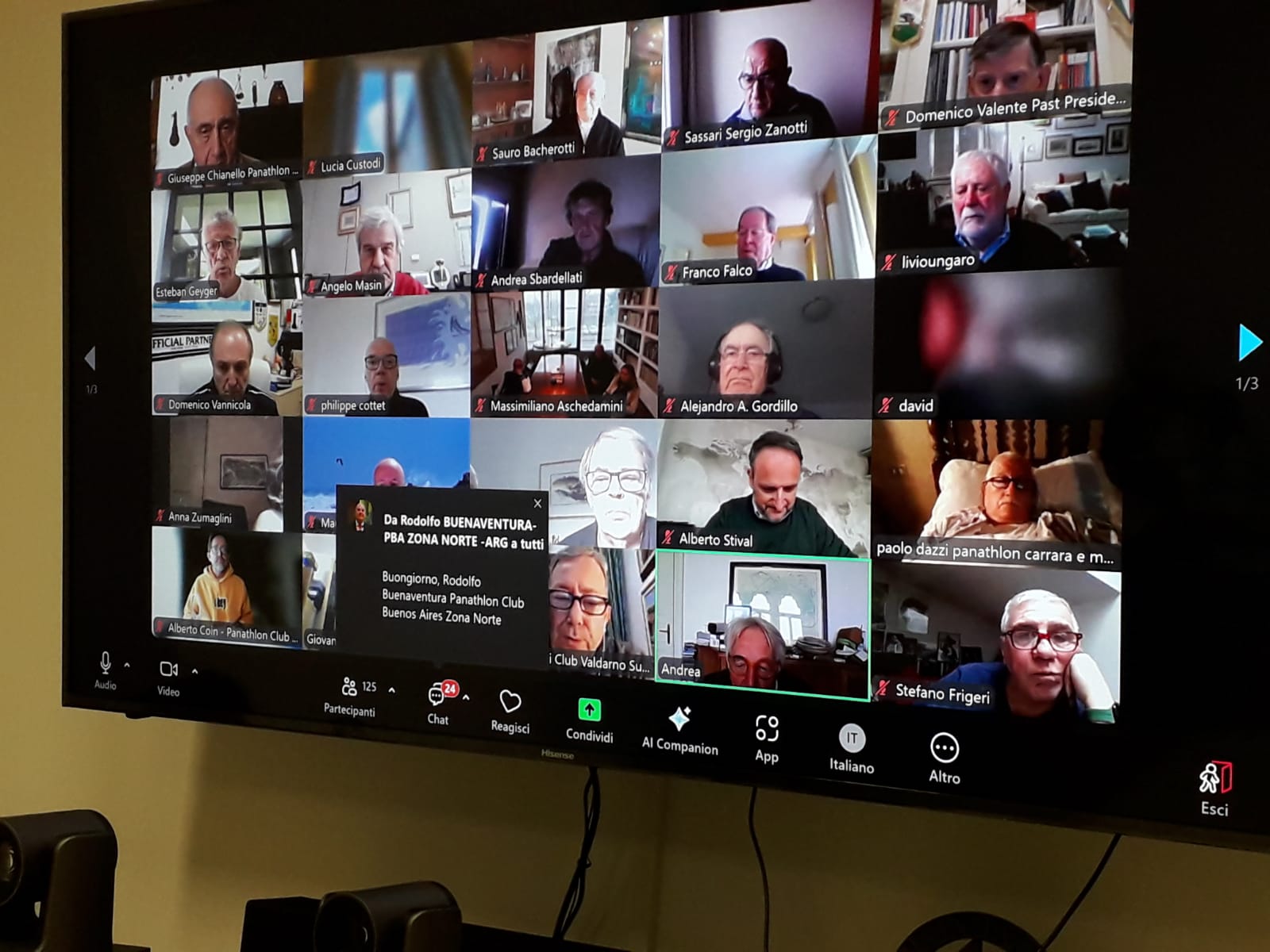
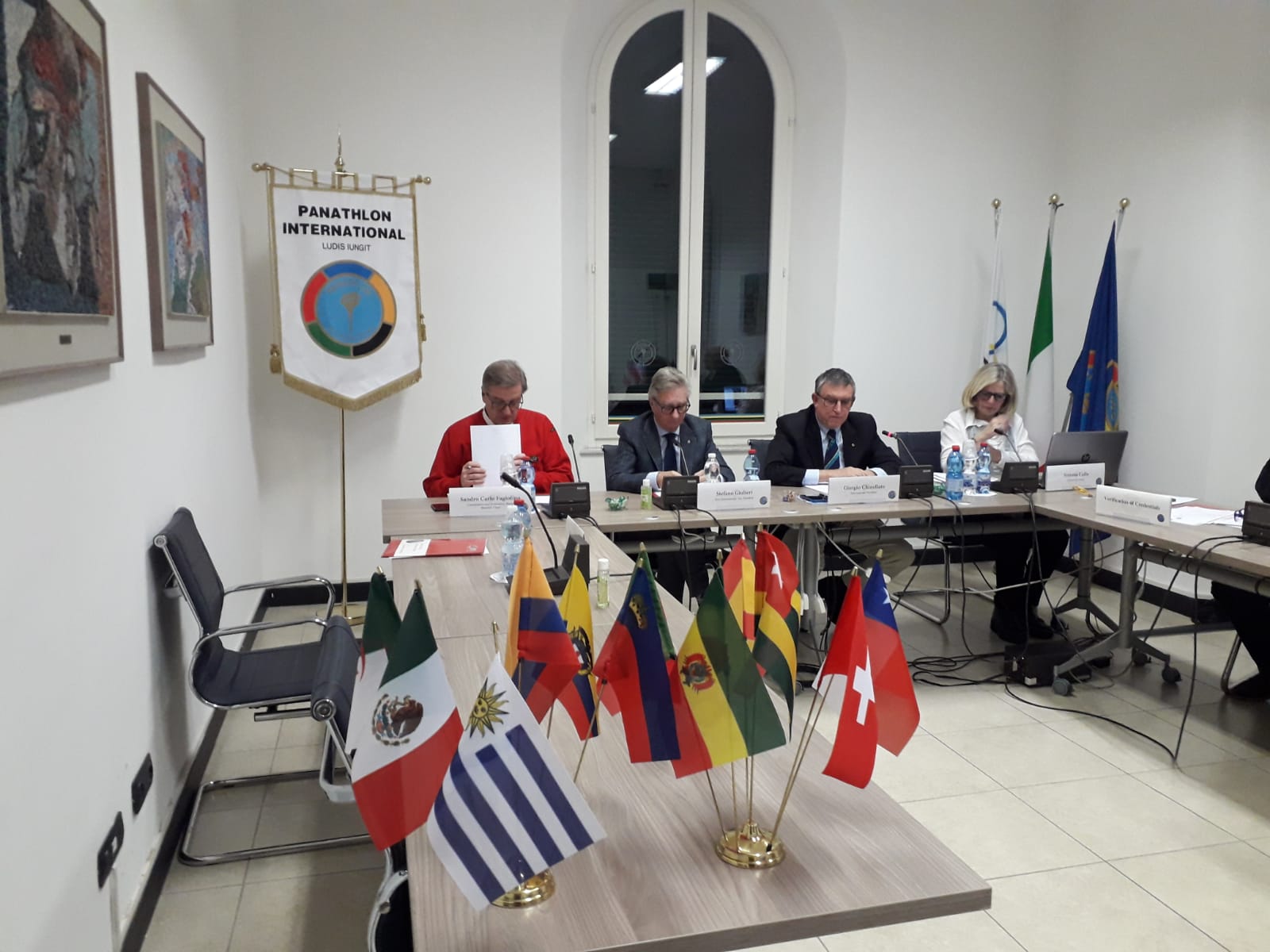
For the first time in the history of Panathlon International, the Extraordinary General Meeting was held online. The event took place on Saturday 14th December at 3 p.m. (CET), with the participation of as many as 196 panathletes, gathered to discuss the main item on the agenda: the increase of the membership fees to PI for the next biennium. President Giorgio Chinellato started the proceedings by appointing the Vice-President, Secretary and scrutineers, and explained the reasons that prompted the International Board to propose the increase.
The main reasons included: the need to support PI's international activities, including expansion and new projects; the absence of fee increases for more than 20 years, the opportunity to realign the fee to the effects of inflation and to compensate for the loss of revenue due to the decrease in membership. The President noted the Assembly's decision and stated that the work of the PI would be reorganised considering this choice. He then addressed special thanks to all those who had collaborated with their hard work in the previous months and to the participants for their presence.
In conclusion, the President wished Merry Christmas and Happy New Year, and declared the Meeting closed at 17:15.